The Internet of Things (IoT) has fundamentally transformed commercial and industrial operations by connecting physical devices to cloud networks, enabling vast ecosystems of real-time data exchange and automation. As these connected technologies migrate from low-risk consumer applications into high-integrity domains—such as smart medical infrastructure, autonomous transit networks, and Industry 4.0 factories—the consequence of an electronic failure escalates dramatically.
When an IoT device interacts directly with the physical world through sensors and actuators, its operational integrity transitions into a functional safety directive. Under master standards like IEC 61508 and ISO 26262, a connected architecture must possess active electrical, electronic, and programmable electronic (E/E/PE) safety mechanisms to detect faults, prevent hazardous conditions, and force the system into a predictable safe state.
Core Areas of the Safety-IoT Intersection
Integrating distributed, internet-facing assets with active functional safety loops requires addressing five primary engineering domains:
1. Systemic Risk Management
IoT architectures operating in safety-critical settings must be structurally hardened against device malfunctions, component wear, and malicious network interference. Applying international guidelines like IEC 61508 or ISO 26262 early in the design cycle guarantees that potential operational hazards are identified systematically. This allows engineers to allocate target Safety Integrity Levels (SIL) or Automotive Safety Integrity Levels (ASIL) directly to the underlying software and hardware nodes.
2. Safety-Critical Communication Architecture
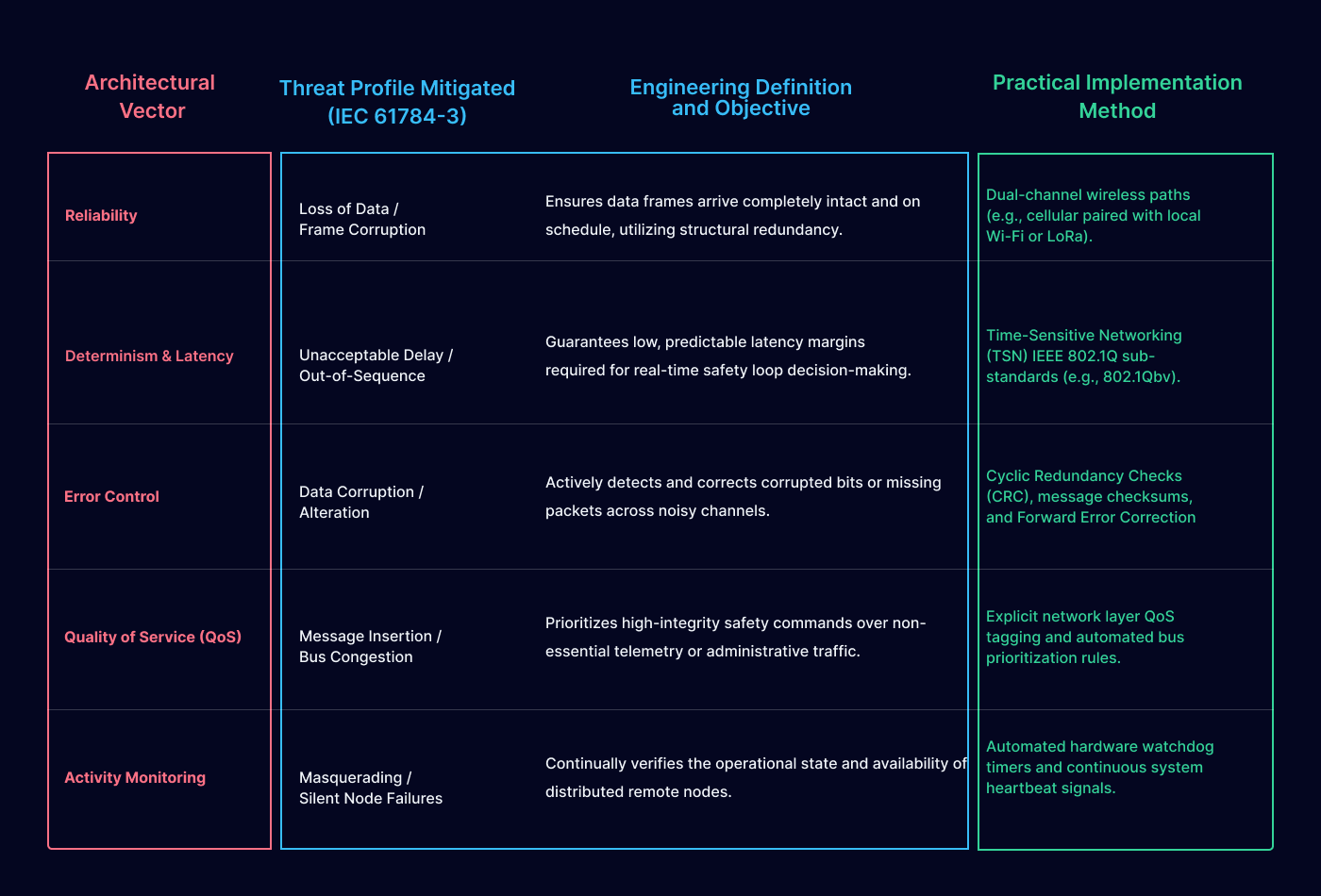
Connected ecosystems depend on continuous, high-volume data transmissions, frequently over wireless networking configurations. Any message corruption, frame loss, packet delay, or unauthorized data injection can result in an immediate loss of control, leading to dangerous physical failures.
To mitigate these transmission anomalies, safety-critical communication loops require specific architectural attributes:
3. The Functional Safety and Cybersecurity Convergence
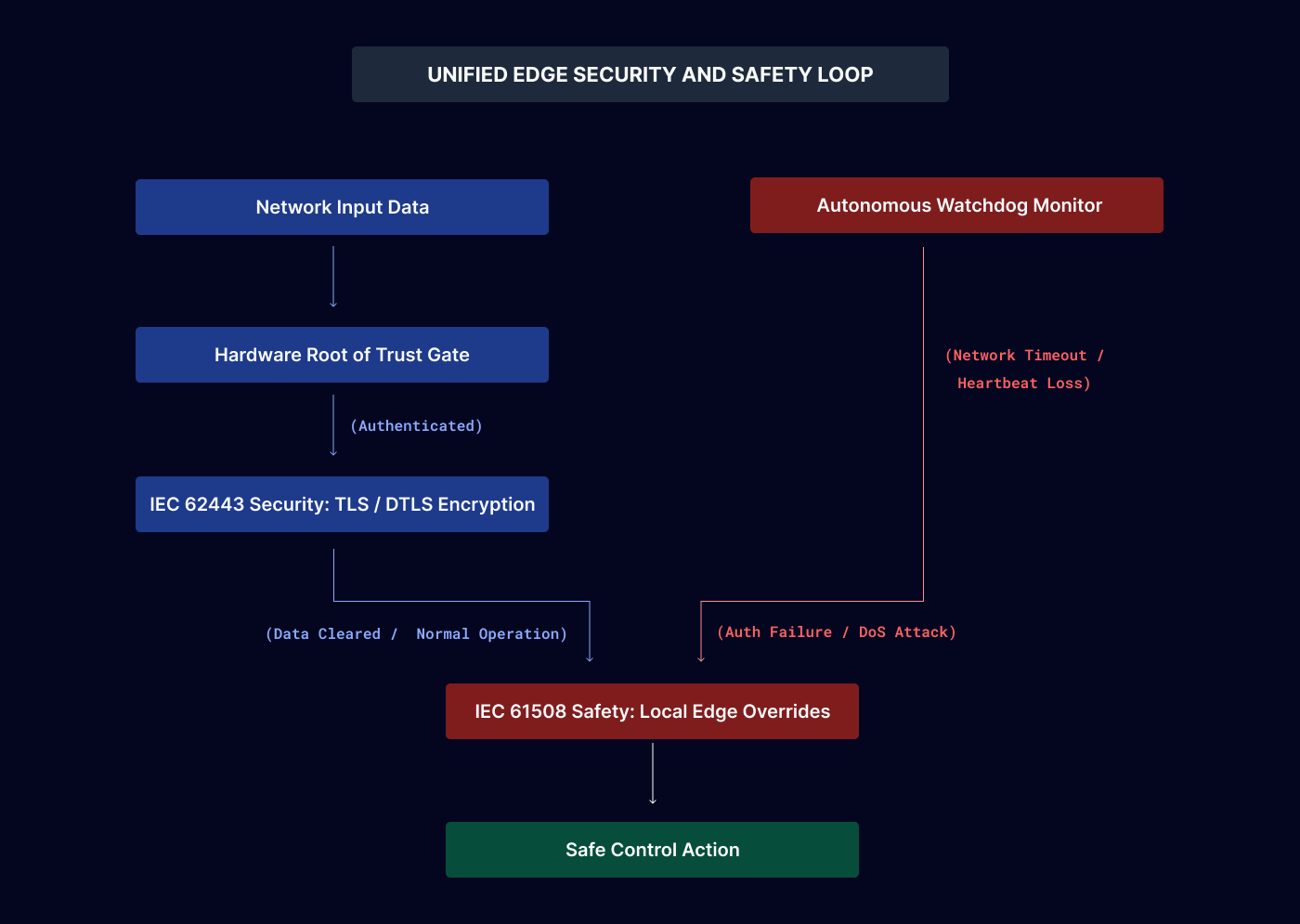
As physical safety systems interface with open internet connections, functional safety and industrial cybersecurity become inseparable. A successful network breach or denial-of-service (DoS) attack on an operational device directly risks the impairment of its protective functions.
Consequently, high-integrity IoT engineering demands strict alignment between functional safety processes and cybersecurity frameworks, such as IEC 62443 for industrial automation security. This requires implementing hardware-root-of-trust authentication, Transport Layer Security (TLS) or Datagram Transport Layer Security (DTLS) encryption, and secure cryptographic key management across all edge nodes.
4. Real-Time Distributed Monitoring and Edge Processing
Integrating IoT components allows for real-time diagnostic monitoring across complex hardware topologies. Connected sensors can continually capture operational data, running anomaly detection algorithms to identify performance drift before a critical failure manifests.
To maintain low latency and eliminate dependency on unstable cloud connections, high-integrity systems leverage edge processing. By executing safety logic and hazard evaluation locally on the physical device, the asset can autonomously trigger localized safety overrides or execute a controlled shutdown if communication lines to the broader network cut out completely.
5. Continuous Lifecycle Validation and Compliance
IoT devices are dynamic platforms characterized by continuous feature rollouts, configuration adjustments, and over-the-air (OTA) software patches. Under functional safety regulations, any modification to code running on a certified device demands an exhaustive regression testing and validation cycle.
Organizations must deploy continuous validation frameworks to trace software modifications back to the initial Safety Requirements Specification (SRS). This ensures that secondary firmware upgrades do not introduce systematic bugs or compromise the performance level of active safety functions.
Implementation Challenges in Connected Safety Loops
Cascading Architectural Complexity:
IoT architectures integrate diverse hardware configurations, third-party software stacks, and multi-layered networking protocols. This structural complexity introduces unpredicted hidden dependencies, making it exceptionally difficult to verify complete system behavior under simultaneous fault conditions.
Protocol Interoperability Bars:
Industrial settings often deploy devices from an array of independent manufacturers, each utilizing different underlying software frameworks. Achieving consistent safety enforcement requires forcing these nodes to communicate via standardized, safety-certified field protocols, such as OPC UA Safety, Data Distribution Service (DDS), or specialized MQTT implementations configured with strict QoS constraints.
Data Integrity Maintenance:
High-volume telemetry networks face continuous data degradation risks from electromagnetic noise or packet collision. If corrupted signal data bypasses verification filters, control systems can execute incorrect, dangerous actions, compromising workplace safety.
Unpredictable Regulatory Environments:
The international regulatory landscape governing the intersection of IoT connectivity, artificial intelligence, and functional safety continues to shift rapidly. Navigating differing compliance mandates across independent geographic markets presents a major barrier for multi-national platform deployments.
Future Horizons for Connected Safety
As Industry 4.0 methodologies, automated smart cities, and driverless logistics fleets expand, the dependency on unified functional safety and IoT frameworks will intensify. Future engineering cycles will increasingly leverage embedded artificial intelligence and machine learning components to optimize predictive maintenance tracks and automate complex hazard evaluations.
To succeed in this evolving domain, platform manufacturers must integrate industrial cybersecurity and functional safety directly into the baseline product design architecture. This approach ensures that interconnected networks can scale efficiently while maintaining an absolute commitment to fail-safe operation and human protection.